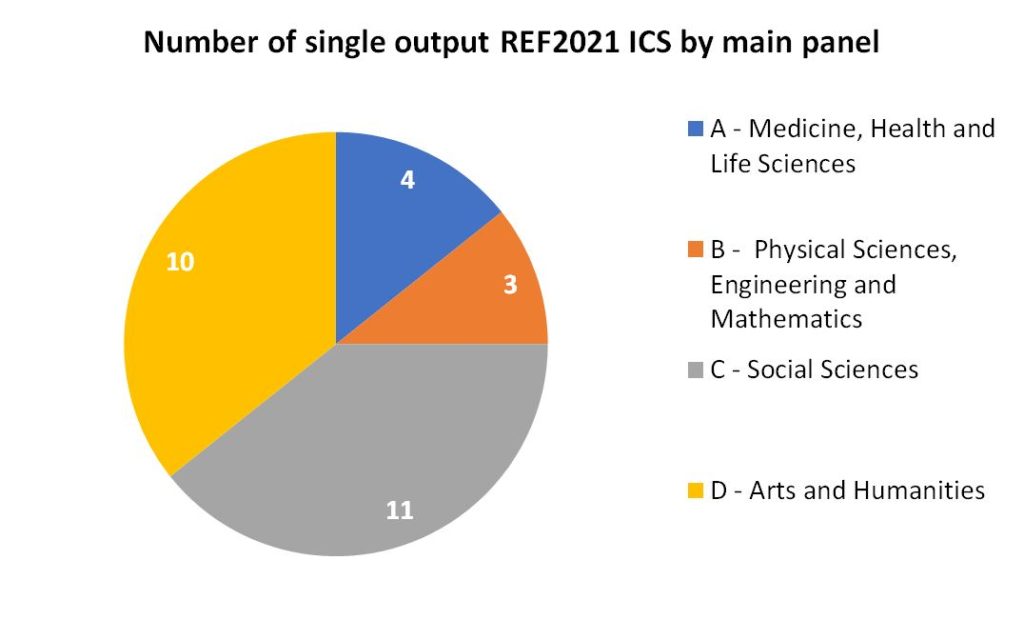
REF impact case studies need to include evidence to corroborate claimed impact. This evidence can take many forms, quantitative or qualitative. Statements from research users, partners and beneficiaries can be a powerful form of evidence, both quantitative and qualitative, as seen in REF 2014 and REF2021.
An analysis of REF2014 impact case studies (Collecting Research Impact Evidence, 2016) showed that testimonials were the most commonly used evidence sources in all areas except in Main Panel A where they were the second most popular form of evidence after “reports” (which makes sense as medical-type impacts are often described in quantitative terms and formal evaluation is important).
There is the temptation to wait until closer to the REF2029 deadline in 2028 to start thinking about/gathering testimonials but it is a better idea to start at least planning this aspect now. What testimonials might you need, who can provide them and what will your approach be? This guide (a significant update on my 2018 post) will go through some key points including what makes a strong testimonial, what to include, how to gather them and a comparison of some indicative weaker vs stronger examples from across sectors/impact types.
Why are testimonials important?
- Testimonials verify the link between the underpinning research and the impact. This attribution or contribution is important as it can be hard to show definitively in other ways.
- Testimonials corroborate or confirm your impact claims. You may be able to state what changed but testimonials back this up in a way that other sources don’t.
- Strong testimonials include information on the reach and significance of the impact. What the change was, what was the resulting benefit or outcome, who was affected and why this matters. This description is best presented as a mix of quantitative and qualitative information. Broadly, quantitative information shows an effect. The qualitative aspect describes the importance of this effect.
- Following on from the previous point, while other sources may show a change or effect, testimonials can put this into context. Consider a 1% decrease in power consumption of some industrial process. Is this a significant impact? It’s impossible to say unless you (or the reader/panel member) know the context! Normally you might say 1% is in the noise and therefore it isn’t even clear if a change has happened, let alone whether it is significant. But a testimonial has the scope to provide context, maybe in this case that the industry partner usually considers a 0.1% improvement to be a big step (with an example where possible). Against this backdrop, the 1% improvement based on your research is a massively significant advance! The testimonial could then give further detail about the significance of this, e.g. across the global operations of this organisation, the change means an £XXXX saving in costs and a reduction of XXXX tonnes of CO2.
- A testimonial may well include information you can’t get elsewhere. For example, a partner may be the only organisation that gathers the required kind of data or performs regular monitoring/evaluation. They may provide proprietary or confidential information that you can’t get anywhere else (if you do need to use confidential information, REF has a number of measures to make this possible and reassure partners – see section 11 in the REF2029 guidance). Even where data is publicly available, it may be cleaned, sanitised, only published periodically, etc whereas a testimonial has the potential to include fuller, richer, tailored, up to date information.
- Testimonials usually come from someone with authority, responsibility or ownership of an organisation, process, service, etc. This gives credibility to the corroboration and impact information.
Features of a strong testimonial
- Specificity – exactly what changed, when, and how
- Link to research – researcher and study clearly identified, pathway described
- Significance – details of changes in policy, practice, behaviour, cultural, economic, etc
- Reach – details of who benefited: people, departments, audience, geographic scope, etc
- Credibility – written by senior staff or influential beneficiaries
What to include – a checklist
In general testimonials should:
- Be written on the external organisation’s headed paper (or a suitably professional-looking email).
- Be signed by someone at an appropriate level. This will vary by case study but considerations should include seniority vs connection to the research (e.g. should the statement come from your direct contact, the person with responsibility for the area or the head of the organisation?), maturity of relationship, reputation and conflicts of interest.
- Name the researcher and refer to the research (could be in descriptive terms, citation of a research output, name of research programme – whatever comes across as most fitting).
- Describe how the organisation “found” or interacted with the research/researcher.
- Describe how the work fits with the organisation’s activities, strategy, needs, challenges, opportunities and other drivers.
- Describe how the research/knowledge/skills were put into action or used, e.g. did the organisation work with the academic (maybe through commissioned research, consultancy, knowledge transfer grant, advisory work, other joint activities), did they use the research in their decision making, did they train their staff according to the research?
- Describe what happened as a result of using the research/knowledge/skills or working with the researcher, e.g. did they produce guidelines for practice, were they better informed in making strategic decisions, was their service provision directly improved?
- Describe the resulting impact of this work. What was the benefit of using the research/knowledge or working with the researcher? Include quantitative or qualitative indicators to show the impact. That is, how they know the change was beneficial. They could also say where they’d be if they hadn’tused the research. This is the most important parts of the statement as it’s where the impact is really articulated (and any quantitative/qualitative evidence the organisation provides can be quoted in the case study and woven into the narrative).
- Describe who benefitted, e.g. people, departments, audience, geographic scope, etc
- Describe the context, both why this chance matters and the organisational context such as the scope and scale of their activities.
- Include dates. This is important as REF will only credit impact that occurred from 1 August 2020 to 31 July 2028. Any vagueness about when things happened means panels may not recognise the associated impact.
- Say something about the future – what’s next in this line of work? Do they foresee continued and growing benefits? Will they work with the researcher again? Will they be more open to using academic research in the future? Maybe they’ll change the way they operate as a result of the impactful piece of work.
How to gather testimonials
The first (and by far the best) option is to put the above list into your own words (so it doesn’t sound so much like a checklist) and use this to prompt a statement from your partner. You could either put it in writing and let them respond accordingly or you could use this as the basis of a conversation/interview. The beauty of the latter approach is that you can explore and clarify and it may uncover other relevant information.
Secondly, you could use the above list as a checklist/questionnaire. I wouldn’t recommend this approach. It may save time but you are unlikely to get the richness or authenticity of a more personal/tailored interaction. It won’t strengthen your relationship with the organisation and it may even damage it.
Finally, in some cases it may be necessary to essentially write the statement yourself and hand it over to the partner to sign. This is not recommended as you lose the authentic voice and you may miss some aspect of what made the work so valuable (including possibly some extra information the partners would have included if they’d had to write it themselves). On top of this there is a very real risk that if the academic writes a number of such letters for different partners to sign, they could all end up looking fundamentally the same which undermines credibility and authenticity. Consider how you’d view this as an assessor…
Other considerations
- Make sure the person giving the statement knows what it is for and has the authority to give it.
- Observe the relevant data management and ethics policies as you gather, hold and use this information.
- In previous REF exercises, some organisations were overwhelmed with requests for testimonials to the point where relationships were affected and in some cases they simply refused to provide testimonials. This is where strong relationships really count so focus on lasting, rather than superficial, interactions with stakeholders and partners.
- Some organisations will be concerned about confidentiality. There are a number of provisions for this. Panel members under confidentiality obligations as standard. If there is a conflict of interest with any individual involved in the assessment, you can alert the REF team and the information will not be made available to them. There is the facility to redact information from case studies when they are made publicly available on the REF impact database. Or they could be completely withheld from the database and not published publicly at all. See section 11 in the REF2029 guidance.
- Don’t wait to get testimonials. The details, nature and value of impacts may become forgotten over time so jump on them while they’re fresh. Plus you never know where people will be in a couple of years.
Using testimonials
The main thing to remember here is that REF panel members do not routinely read the corroborating sources themselves. They will look at a small sample of sources for verification purposes only, i.e. is the evidence really what the author is claiming? For the actual assessment, panel members have to rate the impact case study as it is presented to them. Impact case studies must be self-contained. This means that any important information in the sources must be included in the case study itself, usually in the “Details of the impact” section. Include quantitative information in your description of the impact and use direct quotes where necessary, for example to explain the significance of a change.
(Fictitious) Examples of weaker vs stronger testimonials
Note: these examples would be the central elements of testimonials. The whole testimonial will be in a formal latter/email format with introduction, signoff, etc.
1. Industry/commercial impact:
- Weaker: “Dr Zhang’s work on sustainable materials has been very useful to our R&D team. We have incorporated some of her findings into our product development discussions, and her research continues to shape our thinking about greener production methods.”
- Stronger: “Between September 2020 and July 2022, Dr Zhang’s research on lignin-reinforced biodegradable polymers informed the development of our EcoPack™ packaging line.
Her experimental data and material formulations were incorporated into our R&D process, leading to a reformulated packaging material that reduced petroleum-based polymer use by 35% while maintaining required strength and durability standards.
EcoPack™ was launched in June 2022 and achieved EU compostability certification in April 2023. In its first 18 months on the market, it generated £8.6 million in revenue.
Dr Zhang’s research was critical to the technical viability and regulatory compliance of this product line and continues to guide ongoing sustainable packaging development.
2. Policy impact
- Weaker: “Dr Alvarez’s research on urban transport policy has informed our city planning work. His recommendations were discussed at several policy meetings, and they have influenced how we think about congestion and public transport investment. His research continues to be part of our planning discussions.”
- Stronger: “Between March 2021 and June 2022, Dr Alvarez’s research on congestion management and sustainable urban transport directly informed the City Council’s Transport Strategy 2022–2027.
His modelling of traffic flows and evaluation of low-emission zones was discussed in three formal policy workshops with senior planning officers and was incorporated into the Council’s decision to expand the Low-Emission Zone to cover five additional districts.
Following implementation in September 2022, average peak-hour traffic congestion decreased by 12% across the newly included districts, as measured by city traffic sensors, and public transport usage in these areas increased by 8%.
Dr Alvarez’s research was the principal evidence underpinning these changes and continues to guide the Council’s urban mobility planning.”
3. Third sector/NGO impact
- Weaker: “Professor Simmons’ research on youth engagement has informed our programme design. Her insights have been helpful for our staff and have shaped the way we run workshops. We continue to refer to her work when developing new projects.”
- Stronger: “Between February 2021 and November 2022, Professor Simmons’ research on youth engagement strategies informed the design of our “Youth Voices” programme across five community centres.
Using her evidence-based framework, we revised workshop formats, introduced peer-led discussion sessions, and implemented structured feedback mechanisms. These changes directly impacted 412 young participants aged 14–18.
Evaluation data collected in December 2022 show a 42% increase in participants reporting improved confidence in civic engagement, compared to the previous programme model.
Professor Simmons’ research directly shaped these programme improvements and continues to guide the design of new youth engagement initiatives.”
4. Cultural/heritage impact
- Weaker: “Dr Rahman’s research on local migration history has informed the design of our exhibitions. Her work has helped us interpret our collections differently, and it continues to influence how we plan public engagement activities.”
- Stronger: “Between June 2021 and September 2022, Dr Rahman’s research on post-war South Asian migration informed the design of our exhibition “Arrivals and Afterlives: South Asian Stories in the City”, which ran from October 2022 to February 2023.
Her work directly shaped the interpretive framework, guided the thematic structure of the galleries, and informed the inclusion of 43 newly recorded oral histories.
The exhibition attracted 21,486 visitors, making it the second most visited temporary exhibition in our history. Visitor survey data (n=1,204) indicate that 68% of respondents reported an increased understanding of the history of local migration communities.
Following the exhibition, we revised our Collections Development Policy (July 2023) to prioritise community co-curation and oral history acquisition in under-represented migrant histories.”
And finally…
I hope this is useful!